Asia
The best time to visit Thailand
Two coastlines with opposite monsoons mean there is almost always a sunny beach somewhere, if you know which one.
- Best months
- Nov to Feb
- Think twice
- Sep
- Quietest
- September
- Cheapest
- September
The straight answer
The best time to visit Thailand is November through February: cool-season weather in Bangkok and the north, and dry, calm conditions on both the Andaman and Gulf coasts at once.
November through February is the answer for the classic Bangkok-plus-islands trip. That is Thailand's cool season, a relative term, with Bangkok highs near 90F (32C) but mercifully lower humidity, the north pleasantly crisp, and both coasts at or near their best simultaneously. It is also high season, so book the famous islands ahead.
Outside that window, the trick is that Thailand has two coasts on opposite monsoon schedules. The Andaman side (Phuket, Krabi, Koh Phi Phi, Koh Lanta) gets its heavy rain roughly May through October, when seas turn rough and some ferry routes stop. The Gulf side (Koh Samui, Koh Phangan, Koh Tao) stays largely workable through the summer and takes its wettest weather instead around October through December. A summer trip is not doomed; it just needs to point at the right coast.
The other date to plan around is Songkran, Thai New Year in mid April, when the entire country turns into a nationwide water fight. It falls in the hottest month of the year, which is exactly the point. It is enormous fun and a real travel crunch: Thais go home, transport fills, and you will get soaked in the street whether you enrolled or not.
Thailand, month by month
Every month gets a verdict. Tap one for its own page: weather, crowds, prices and what is on.
- 01JanuaryBestDry and 'cool', Bangkok highs near 89F (32C), northern mornings crispPeak season at full stride: both coasts sunny, the north at its finest. Book islands and the famous beach resorts well ahead.Hotels for January →CrowdsPrice
- 02FebruaryBestDry and warm, highs near 91F (33C)Still prime everywhere. In the far north, late-season agricultural burning can begin hazing the air late in the month.Hotels for February →CrowdsPrice
- 03MarchGoodHeating up, highs near 93F (34C)Beaches remain excellent as crowds ease. The north's burning-season haze is at its worst roughly February through early April; save Chiang Mai for another window.Hotels for March →CrowdsPrice
- 04AprilTradeoffsThe hottest month, highs near 95F (35C)Brutal heat, softened by Songkran's nationwide water fight in mid April. Transport and hotels jam around the holiday as the whole country travels.CrowdsPrice
- 05MayTradeoffsHot with building rain, highs near 93F (34C)The Andaman monsoon arrives: rough seas and storms on the Phuket side. The Gulf islands stay largely sunny. Prices drop nicely.CrowdsPrice
- 06JuneTradeoffsWarm and humid, highs near 91F (33C), showers in burstsA decent value month if you aim at the Gulf coast (Samui, Phangan, Tao). Bangkok and the north see rain mostly in afternoon storms.CrowdsPrice
- 07JulyTradeoffsHumid, highs near 90F (32C), regular rain on the Andaman sideSummer-holiday travelers lift crowds despite the season. Gulf islands remain the smart beach pick; Andaman seas are moody.CrowdsPrice
- 08AugustTradeoffsHumid with frequent showers, highs near 90F (32C)Similar story: workable in Bangkok and on the Gulf coast, wet and rough on the Andaman. Green-season rice terraces in the north are beautiful between storms.CrowdsPrice
- 09SeptemberThink twiceThe wettest month, highs near 89F (32C)Peak monsoon nearly everywhere: flooded streets in Bangkok some years, heavy Andaman seas, and rising rain on the Gulf. The year's lowest prices are the honest consolation.CrowdsPrice
- 10OctoberTradeoffsRain easing in the north and center, highs near 89F (32C)Transition month. Bangkok and Chiang Mai improve week by week while the Gulf coast enters its own wettest stretch, which runs roughly October into December.CrowdsPrice
- 11NovemberBestDrying and bright, highs near 89F (32C)The cool season arrives with the Loy Krathong lantern festival. Andaman ferries resume full schedules; the Gulf can still see late-year rain.Hotels for November →CrowdsPrice
- 12DecemberBestDry, sunny, the year's most comfortable air, highs near 88F (31C)Superb everywhere except a rain-prone Gulf early in the month. Christmas to New Year is the single most booked, most expensive stretch of the year.Hotels for December →CrowdsPrice
Book Thailand for November.
Sponsored links to Expedia and Vrbo. We may earn a commission; it never changes a verdict.
- Hotels for November
Hotels. Expedia
Hotels in ThailandOpens a hotel search for Thailand in November, dates filled in. Book early for the best months: the good rooms go first.
- Rentals on Vrbo
Vacation rentals. Vrbo
Vacation rentals in ThailandWhole homes, condos and villas. Usually the better deal for families and groups, with a kitchen and room to spread out.
- Tours and tickets
Tours and tickets. Expedia
Tours and tickets in ThailandTimed-entry tickets, day trips and guided tours in Thailand for November. Popular slots sell out in the best months.
Why go to Thailand
The best-value great destination on Earth
Street food for two dollars, beach bungalows for forty, and five-star hotels at half what they cost elsewhere. Thailand delivers more trip per dollar than almost anywhere.
Food worth the flight by itself
Bangkok street stalls, northern khao soi, southern curries: Thai food at the source is a different sport from Thai food abroad, and eating it is a legitimate itinerary.
Islands for every temperament
Party islands, dive islands, family islands, hammock islands. With two coasts and dozens of islands, there is a beach matched to exactly the trip you want.
Culture that is easy to reach
Gilded temples in Bangkok, ancient capitals at Ayutthaya and Sukhothai, and the temple-studded mountains of the north, all connected by cheap flights and comfortable trains.
Things to do, and when to do them
Bangkok's Grand Palace and Wat Pho
The gold-spired heart of Thai royalty and the giant Reclining Buddha next door. Go at opening, dress with covered shoulders and knees, and ignore anyone outside saying it is closed.
Bangkok street food crawl
Chinatown (Yaowarat) after dark is the classic run. Follow the lines of locals; the busiest stall is the menu.
Chiang Mai's old city and temples
Moat-ringed lanes, hundreds of temples, and the mountain shrine of Doi Suthep above town. Best November through January; skip burning season in late winter.
Railay and Krabi's limestone coast
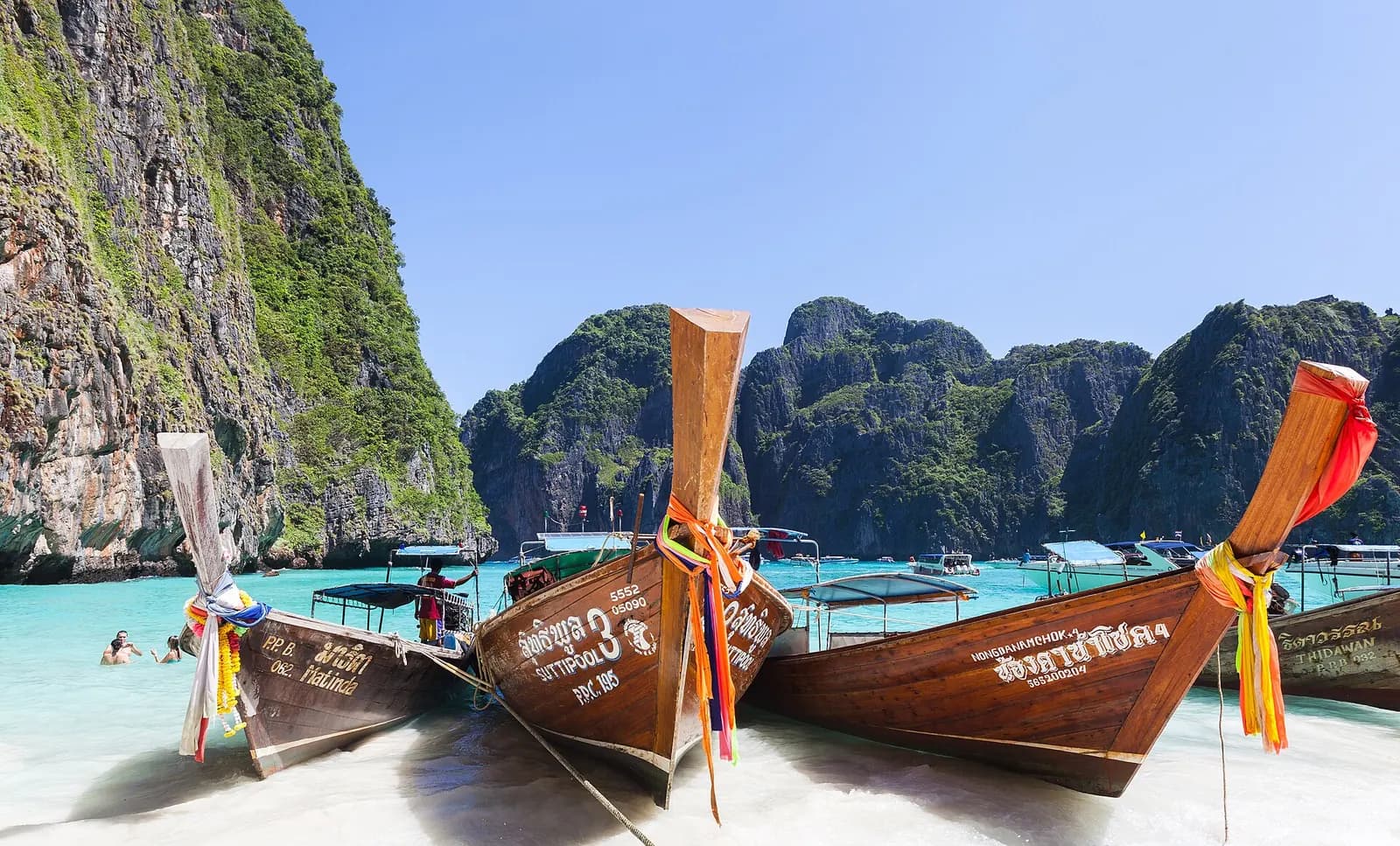
Karst cliffs straight out of a painting, reachable only by longtail boat. Calm seas and full boat schedules run roughly November through April.
Koh Phi Phi and Maya Bay
The famous bay operates with visitor limits and seasonal closures to let the ecosystem recover. Check current rules and book the earliest boat.
Gulf islands: Samui, Phangan, Tao
Resorts on Samui, full-moon energy on Phangan, and some of the world's cheapest dive certification on Koh Tao. At their best when the Andaman side is stormy.
Ayutthaya day trip
The ruined former capital, its Buddha head wrapped in tree roots, is 90 minutes from Bangkok by train. Go early; it is an open oven by noon.
An ethical elephant sanctuary near Chiang Mai
Observation-based sanctuaries, no riding, no shows, are the standard worth seeking out. Book reputable operations ahead; they cap group sizes.
Events and seasons worth planning around
Songkran (Thai New Year)
Mid April
The world's biggest water fight, nationwide, in the year's fiercest heat. Joyous chaos in Bangkok and Chiang Mai; intercity transport sells out as Thais travel home.
Loy Krathong
The full moon of the twelfth Thai lunar month, usually November
Candlelit floats on every river and pond. In Chiang Mai it coincides with Yi Peng's famous sky lanterns; book that city months ahead.
Chinese New Year
Late January or February, date follows the lunar calendar
Bangkok's Chinatown throws one of the biggest celebrations outside China: lion dances, red lanterns, and glorious eating.
Phuket Vegetarian Festival
Nine days in late September or October, date follows the lunar calendar
A dramatic Taoist festival of processions and ascetic displays, some graphic. One of Thailand's most intense spectacles.
Andaman high season
November through April
Calm seas open every ferry route and dive site on the west coast, including the Similan Islands park, which closes roughly mid May to mid October.
Beat the crowds
- Go in November or February: you get the cool-season weather of the December-January peak with a real step down in crowds and prices.
- Pick one second-tier island (Koh Lanta, Koh Yao Noi, Koh Kood) over the marquee names; the beach is the same postcard with half the longtail traffic.
- In Bangkok, see the Grand Palace at opening or after 3pm, and ride the river boats and BTS instead of sitting in taxi traffic.
- Book Christmas to New Year and Songkran-week transport like concert tickets, months out. The rest of high season needs only days to weeks of lead time.
- Full-moon party weeks distort the whole Gulf: Koh Phangan fills and neighboring islands feel the surge. Check the lunar calendar when booking Samui or Tao.
Open or closed
- Andaman-coast monsoon (roughly May through October): some island ferry routes stop, boat trips cancel in rough seas, and the Similan Islands national park closes entirely, typically mid May to mid October.
- Maya Bay and several marine parks now enforce visitor caps and seasonal closures for ecological recovery; rules change year to year, so check before promising anyone the famous beach.
- Songkran (mid April) closes many offices and small businesses for days while the whole country travels; tourist attractions stay open and very wet.
- During the Gulf coast's wettest stretch (roughly October into December), Koh Tao dive trips and Samui beach days get rain-checked; the Andaman side is simultaneously reopening.
- Bangkok never closes in any season, but royal and Buddhist holy days shut government sites for a day and pause alcohol sales nationwide; a handful land on shifting lunar dates through the year.
With kids in tow
- Thailand is a superb family destination: Thais dote on children, food is easy to love (fried rice and mango sticky rice solve most negotiations), and beach resorts cater to kids at every price.
- For swimming with young kids, pick the calm-water windows: Andaman coast November through April, Gulf coast in the summer months. Rough-season surf and longtail transfers are the main hazards to plan around.
- Kid-favorite wins: overnight sleeper trains, elephant sanctuaries done ethically, snorkeling off Koh Tao or Krabi, and Bangkok's canal boats and weekend-market ice cream.
- For homeschool families: November through February pairs the best weather with school-term quiet at the temples and ruins, and Ayutthaya, Thai script, and monsoon geography make a ready-made unit study.
Getting there
- Bangkok's Suvarnabhumi (BKK) is the main gateway, with Don Mueang (DMK) handling many budget carriers. There are no nonstops from the mainland US: one-stop routings run through Tokyo, Seoul, Taipei, Hong Kong, Doha, or Dubai, typically 20 to 24 hours door to door.
- From Texas, connect west through LAX, SFO, or Seattle to an Asian hub, or east through Doha or Dubai; either way it is a two-flight, roughly 24-hour journey, so build in a recovery day.
- Domestic hops are cheap and constant: Bangkok to Phuket, Krabi, Chiang Mai, or Samui runs about 70 to 90 minutes, making a capital-plus-coast itinerary easy in ten days.
Packing? Packing cubes and the airport kit.
Thailand timing, quick answers
What is the best month to visit Thailand?
December and January are the classic peak: dry and relatively cool everywhere. For nearly the same weather with fewer people, November and February are the smart picks.
Which coast should I choose in the rainy season?
The Gulf coast (Koh Samui, Koh Phangan, Koh Tao) from roughly May through September, when the Andaman side is stormy. The pattern flips late in the year: the Gulf's wettest stretch runs about October into December just as Phuket and Krabi dry out.
Is Songkran a good time to visit?
If you want the party, yes: mid April's nationwide water fight is unforgettable, especially in Chiang Mai and Bangkok. Book transport early, waterproof everything, and expect the fiercest heat of the year. If you want quiet sightseeing, choose another window.
What is the cheapest time to visit Thailand?
September, the wettest month, brings the year's lowest prices, with May, June, and early October close behind. Aim at Bangkok plus the Gulf islands and a wet-season trip can still deliver plenty of sunshine.
How many days do I need for Bangkok plus islands?
Ten days is the comfortable minimum: three in Bangkok, a travel day each way, and five or six on one island group. Trying to hit both coasts in one trip under two weeks means spending it in transit.
Weighing alternatives
Similar trips, with their best months.


Before you book.
Sort these two things first.
Sponsored links. We may earn a commission; it never changes a verdict.
- Visit Faye
Travel insurance.
FayeA missed connection, a bag that never turns up, a hospital abroad: far cheaper to cover before departure than to argue about after.
- Visit Saily
eSIM data.
SailySet up an eSIM before you fly so your phone has data the moment you land, without roaming charges.
Our top-rated travel gear
Whatever you decide, this is the gear we actually travel with: verified, priced, and ranked. Live price check on each.






As an Amazon Associate we may earn from qualifying purchases, at no cost to you.